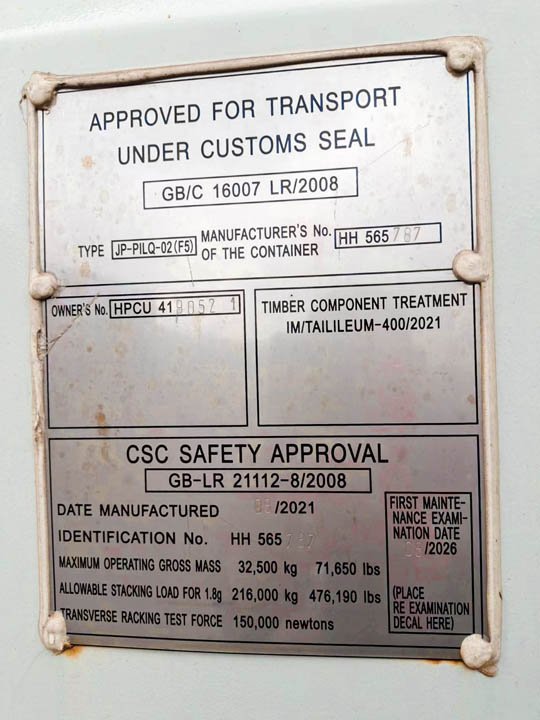
CSC Plate Information
Here's some helpful information about CSC plates that I think you'll find interesting!
Here's some helpful information about CSC plates that I think you'll find interesting!
Whether you are buying, selling, hiring, or shipping a container internationally, understanding CSC plates matters. These small metal plates carry legal, operational, and safety information that shipping lines, depots, and customs authorities rely on. Shipping Containers of London supplies containers for storage and export use across Greater London and surrounding areas, and CSC compliance is one of the first checks buyers should make before arranging overseas transport.
CSC stands for the International Convention for Safe Containers. The agreement was adopted in 1972 by the United Nations and the International Maritime Organisation to create uniform safety rules for freight containers used in international transport. Containers approved under the convention carry a CSC safety approval plate fixed to the container doors.
The CSC plate confirms that the container has passed structural testing and meets minimum international standards for lifting, stacking, and transport. Most containers have the plate riveted to the left-hand cargo door.
A valid CSC plate is required for most international shipping movements. Without one, shipping lines may reject the container before loading.
If you need a container suitable for export use, Shipping Containers of London can supply units with valid CSC certification for shipping and freight operations.
A CSC plate acts as proof that a container is safe to move through ports, rail terminals, and container vessels. During international transport, containers are stacked several levels high and exposed to heavy loads, vibration, lifting forces, and changing weather conditions.
The plate confirms the container has been tested to handle these conditions safely.
For buyers and hirers, this matters for several reasons:
A container used only for static storage on private land does not always require a valid CSC certificate. However, if the container may be exported later, recertification may be needed before shipment.
Shipping Containers of London supplies both storage containers and export-ready units, depending on the intended use.
CSC plates contain technical and compliance information linked to the container. According to BIC guidance, the plate must include key identification and safety data.
You will usually find:
Payload refers to the maximum cargo weight the container can safely carry. Tare weight refers to the weight of an empty container before loading.
The container number shown on the CSC plate should match the markings painted on the exterior doors and the shipping paperwork.
The Convention for Safe Containers sets minimum design standards for the plate itself. The plate must remain legible throughout the container’s working life.
According to BIC guidance, CSC plates must:
These requirements help inspectors read the plate clearly even after years of outdoor exposure and heavy handling.
Containers used for international shipping must remain structurally safe after manufacture. This is managed through inspection programmes.
There are two main systems:
Under PES rules, the first inspection normally takes place within five years of manufacture. After that, inspections must happen at intervals of less than 30 months.
ACEP is widely used by container operators and leasing fleets. Instead of fixed inspection dates, containers are inspected continuously during repairs, depot handling, and operational checks. Containers operating under ACEP display the ACEP reference number on the CSC plate.
If a container suffers serious structural damage, the CSC approval may become invalid until repairs and reinspection are completed.
Before buying or hiring a container, inspect the CSC plate carefully. This is particularly important for export shipments.
Check the following:
You should also inspect the container itself. A valid plate alone does not guarantee acceptance for shipping if the container has major structural damage.
Common problems that may fail inspection include:
Shipping Containers of London can advise whether a container is suitable for storage only or ready for export use.
A missing, damaged, or expired CSC plate can create delays and extra costs during transport.
Shipping lines and ports may:
If the container still meets structural standards, an authorised inspection body may recertify it and issue updated approval details.
For many buyers, it is more cost-effective to purchase a container that already holds a valid CSC certification rather than arranging repairs and reinspection later.
If you plan to use a container for international freight, ask these questions before buying:
Wind and watertight means the container keeps out normal rain and weather during use. Most used storage containers are sold as wind and watertight, but not all are suitable for export shipping.
One-trip containers are often the simplest option for export use because they are newer units with minimal wear and long remaining CSC validity.
You can also compare standard container sizes before ordering:
The initial CSC approval usually lasts for five years from the date of manufacture. After that, containers must follow an inspection programme such as PES or ACEP to remain compliant for international shipping.
Most shipping lines and ports will reject containers without a valid CSC plate. If the plate is missing or expired, the container normally requires inspection and recertification before export.
The CSC plate is usually fixed to the outside of the left-hand cargo door. It may be combined with other approval and customs plates on newer containers.
ACEP stands for Approved Continuous Examination Programme. It means the container is inspected continuously during operation and repair cycles, rather than using fixed reinspection dates.
Containers used only for static storage on private land may not require active CSC certification. However, if the container may later be used for export shipping, a valid CSC approval will usually be needed.
Tare weight is the empty weight of the container itself. Payload is the maximum cargo weight the container can safely carry inside.
Yes. Shipping Containers of London supplies export-ready containers with valid CSC certification, as well as storage-only containers for commercial and domestic use. You can also review our container FAQs for more guidance.
Jeremy and the Team were very easy to work with. extremely quick to respond to our needs and the overall delivery was spot on. The container supplied was brand new and exceptionally clean, ready for our items to be stored safely and securely.
What a totally, refreshingly, brilliant company to deal with. They do what they say they will do at a time they say they will do it. Completely up front about everything: quality, cost, delivery etc. Nothing hidden. They accommodate the customer as far as humanly possible and their communications are spot on. I wish more companies were like this one.
The service from this company was excellent. We were working to tight deadlines and Jeremy was incredibly prompt in his communication, from the initial quote to the follow up email, to check everything had been received. He phoned the haulier and arranged a delivery around our schedule and Andy (the driver), kept us informed, so we knew exactly when he was arriving.
A professional company, that I would recommend highly.
Monday : 9:00–17:30
Tuesday : 9:00–17:30
Wednesday : 9:00–17:30
Thursday : 9:00–17:30
Friday : 9:00–17:30
Saturday : Closed
Sunday : Closed
Tel: 0330 0130 636
Email: info@shippingcontainersoflondon.co.uk