
Delivery Guidelines
Delivery Guidelines Shipping Containers are delivered using a standard container truck or, if required, a hi-ab crane vehicle. When placing the shipping
Delivery Guidelines Shipping Containers are delivered using a standard container truck or, if required, a hi-ab crane vehicle. When placing the shipping
Taking delivery of a shipping container is a significant logistical operation that requires careful planning and precise execution. Whether you are a construction manager requiring site storage or a homeowner seeking additional space, the success of your project hinges on the safe delivery and placement of the unit. At Shipping Containers of London, we combine decades of industry experience with a specialised fleet of vehicles to navigate the complexities of urban and rural deliveries alike.
Shipping containers are heavy, rigid structures that cannot be easily moved once set down, making the initial delivery phase critical. This guide outlines the specific vehicle requirements, site preparation, and access dimensions needed to ensure your delivery proceeds without a hitch. By understanding the logistics involved, you can avoid costly delays and failed delivery charges.
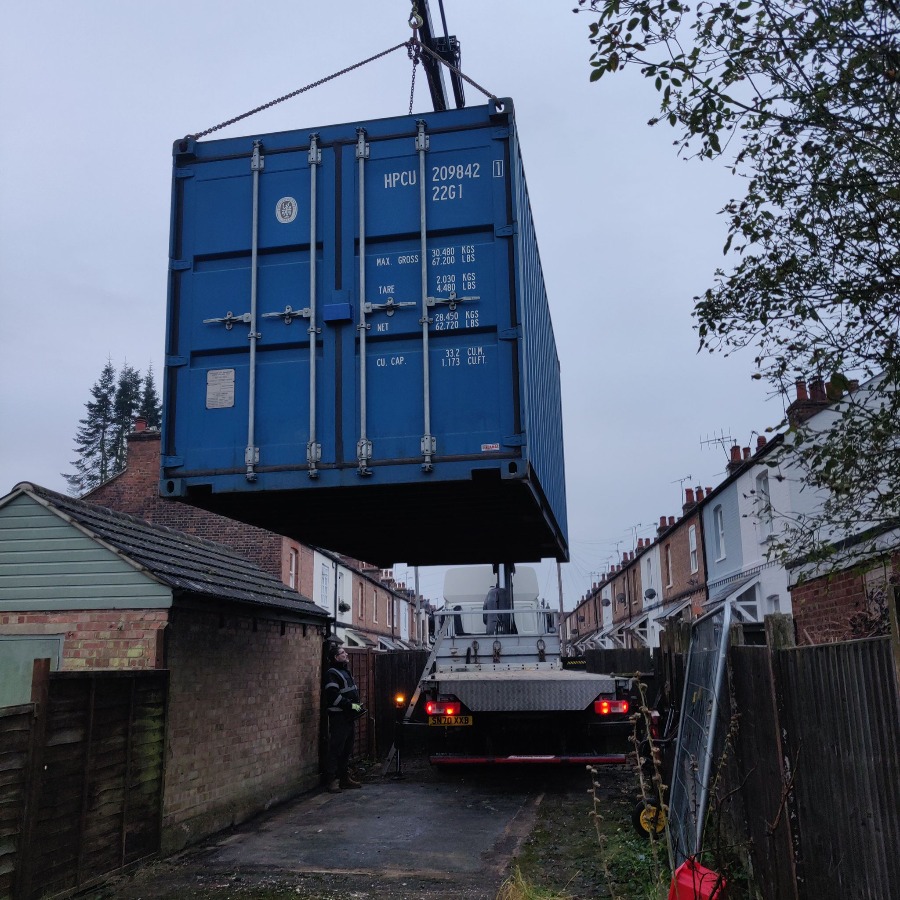
We utilise a network of specialised Hiab crane-equipped trucks to deliver and offload our shipping containers. These vehicles feature a hydraulic crane arm mounted behind the cab, allowing for the unit to be lifted off the side of the vehicle and positioned with precision. It is essential to match the delivery vehicle to both the container size and the access constraints of your site.
The industry standard for delivering a single 20ft shipping container is a rigid Hiab truck. This vehicle is a single chassis unit, similar in size to a large dustcart or fire engine but significantly longer.
For larger units, such as 40ft shipping containers, or for the delivery of multiple 20ft units in a single journey, an articulated vehicle is required. These massive vehicles consist of a tractor unit and a long trailer.
For sites that require the volume of two 20ft containers but lack the space for a 60ft articulated lorry, a "wagon and drag" configuration offers a flexible solution. This consists of a rigid truck pulling a drawbar trailer. The key advantage is manoeuvrability: the driver can disconnect the trailer nearby, deliver the first container on the rigid truck, and then return to collect the second unit from the trailer. This method is often cheaper than arranging two separate delivery runs.
The most common cause of failed deliveries is insufficient access. Unlike small parcels, a shipping container truck requires specific clearances to reach the drop-off point safely. You must verify that your route and site can accommodate the vehicle dimensions before booking your delivery.
The delivery truck itself is approximately 8ft wide, or 9ft including wing mirrors. However, the entrance to your site should ideally be at least 12ft wide to allow for safe manoeuvring. If the approach road is narrow, parked cars or sharp turns can prevent a large vehicle from accessing the site. For articulated vehicles, ensure there is sufficient swing space for the trailer when turning.
Vertical clearance is a critical safety factor. A truck carrying a standard shipping container is approximately 14ft 6 in high. If you are ordering a High Cube container, this height increases to 15ft 6in.
Preparing your site correctly is the customer's responsibility and is vital to the container's longevity and the smooth operation of its doors. Our vehicles must remain on hard-standing surfaces at all times.
When loaded, the delivery vehicle exerts immense pressure on the ground. We cannot drive over grass, mud, soft earth, or loose gravel. If a heavy truck drives onto soft ground, it risks sinking and becoming stuck, leading to costly recovery and potential land damage. Drivers have the right to refuse delivery if they believe the ground conditions are unsafe.
Shipping containers are designed to be supported by their four corner castings. The ground does not need to be a solid concrete slab, but the four corners must be perfectly level with one another. If a container is placed on uneven ground, the structure will "rack" or twist. This distortion causes the door frame to skew, making the heavy cargo doors stiff or impossible to open and close.
To ensure a level foundation and prevent the container from sitting in damp soil, we recommend using supports under the corners, such as:
Raising the container slightly off the ground also encourages airflow, helping the underside dry out and extending the unit's lifespan.
On the day of delivery, knowing what to expect ensures a safe and efficient handover. Our professional drivers will communicate with your site contact to plan the lift.
A "failed delivery" incurs high costs, including the transport charge and a return-to-depot fee. To avoid this, we strongly encourage open communication regarding your site's constraints. If you have any doubts about access, narrow gates, or ground stability, sending photos or a video walk-through to our team can help us assess the feasibility of the job.
For particularly complex sites, we can arrange a site survey. While this is a chargeable service, it eliminates the risk of a failed delivery by ensuring the correct vehicle and lifting method are selected. Whether you require storage containers or complex converted units, getting the logistics right is the first step in a successful project.
No, standard Hiab cranes do not have the reach or height capability to lift a shipping container over a building. If this is required, you would need to hire a specialist mobile crane, which is a significantly more expensive operation.
For a 20ft container delivery on a rigid truck, you generally need around 40ft to 50ft of linear space for the vehicle to park and operate. Additionally, you need approximately 18ft of width to accommodate the truck and the extended stabiliser legs.
Delivering onto grass is generally not possible due to the vehicle's weight, which can exceed 25 tonnes. The truck is likely to sink and get stuck. If the ground is exceptionally dry and hard, a driver may proceed at their own discretion. Still, the customer must often sign a disclaimer accepting liability for any recovery costs or damage.
Yes, an authorised representative must be present on-site to direct the driver to the exact location and sign for the delivery. This person is also responsible for checking that the container doors operate correctly before the driver departs.
Yes, lifting over a standard fence or wall is usually not a problem, provided the obstacle is not too high, and the container is being placed relatively close to the vehicle. However, you must inform us in advance if the lift involves obstacles so we can ensure the crane has sufficient reach.
In many cases, shipping containers are considered temporary structures and may not require planning permission. However, rules vary by location, especially in Areas of Outstanding Natural Beauty or for long-term placement. We recommend checking with your Local Planning Authority to be certain.
Delivery typically takes between 3 to 5 working days from the time of order. During busy periods or for containers requiring modifications, such as painting or installing a lockbox, lead times may be longer.
Yes, we can deliver in the rain. However, severe weather can impact ground conditions, making unpaved surfaces soft and potentially unsafe for the vehicle. If the ground becomes dangerous due to rain, the driver may refuse delivery to avoid getting stuck.
Yes, if you have your own suitable vehicle, we are happy to supply containers "ex depot" for you to collect. Your vehicle must be equipped with twist locks to secure the container, and you must comply with the depot's health and safety requirements.
Jeremy and the Team were very easy to work with. extremely quick to respond to our needs and the overall delivery was spot on. The container supplied was brand new and exceptionally clean, ready for our items to be stored safely and securely.
What a totally, refreshingly, brilliant company to deal with. They do what they say they will do at a time they say they will do it. Completely up front about everything: quality, cost, delivery etc. Nothing hidden. They accommodate the customer as far as humanly possible and their communications are spot on. I wish more companies were like this one.
The service from this company was excellent. We were working to tight deadlines and Jeremy was incredibly prompt in his communication, from the initial quote to the follow up email, to check everything had been received. He phoned the haulier and arranged a delivery around our schedule and Andy (the driver), kept us informed, so we knew exactly when he was arriving.
A professional company, that I would recommend highly.
Monday : 9:00–17:30
Tuesday : 9:00–17:30
Wednesday : 9:00–17:30
Thursday : 9:00–17:30
Friday : 9:00–17:30
Saturday : Closed
Sunday : Closed
Tel: 0330 0130 636
Email: info@shippingcontainersoflondon.co.uk
