
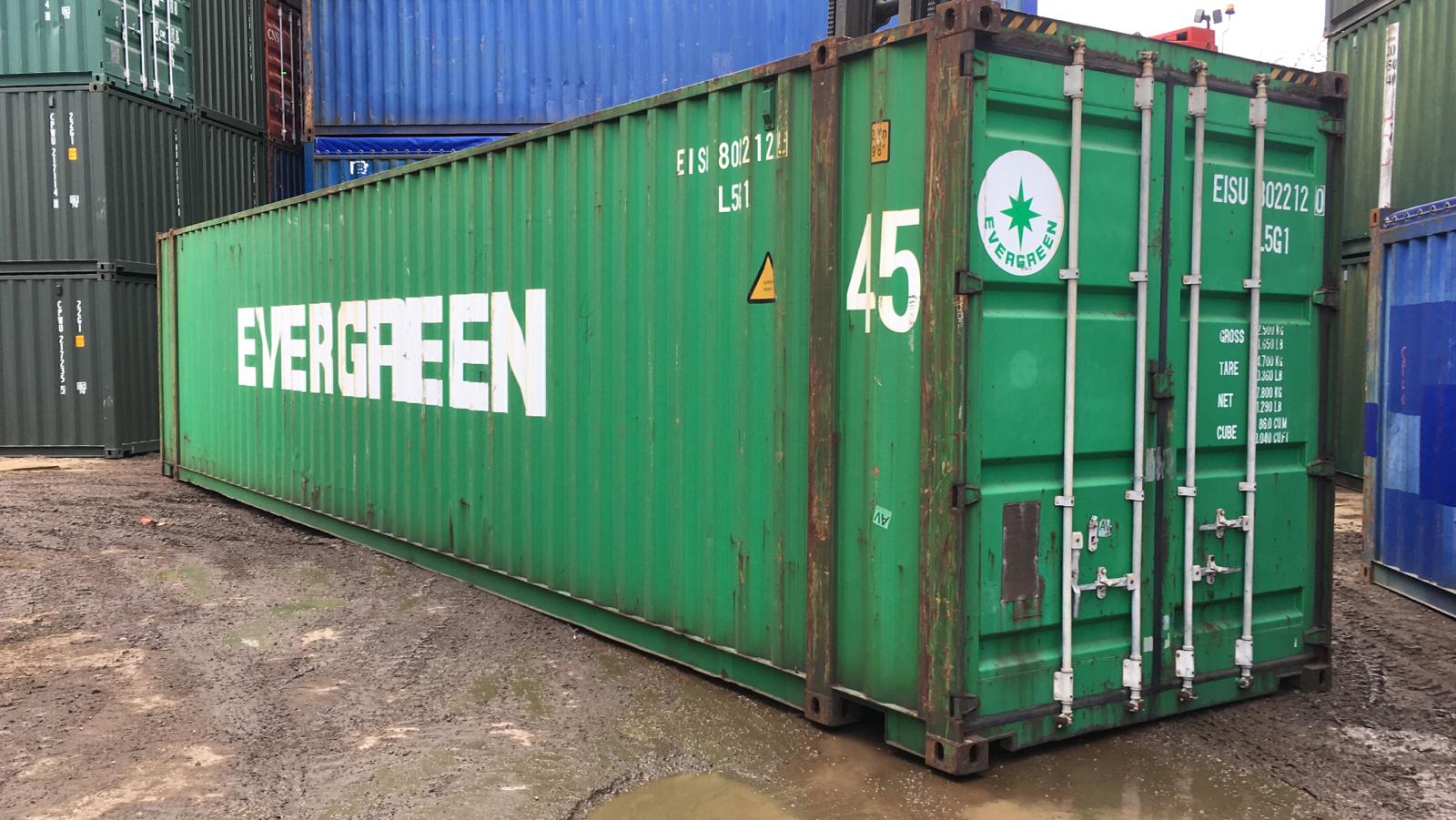
45ft High Cube Container Dimensions
Shipping Containers of London supplies 45ft high cube containers for large-scale retail storage, industrial logistics, and extensive modular conversion projects across Greater London and surrounding transport corridors. The 45ft high cube shipping container represents the maximum standardised volumetric footprint available in the maritime freight market. By combining five feet of extra length over standard large units with an additional foot of vertical clearance, these structures allow commercial operators to move or secure massive quantities of inventory within a single secure steel shell.
45ft High Cube External Dimensions
The external measurements define the massive physical space required to safely accommodate this unit on your premises or transport it flatbed. Accurate site planning is vital given the extended length of the steel frame.
| Measurement | Metric | Imperial |
|---|---|---|
| Length | 13,716mm | 45ft 0in |
| Width | 2,438mm | 8ft 0in |
| Height | 2,896mm | 9ft 6in |
The 9ft 6 in external height means these high cube units stand exactly 1 ft taller than standard freight boxes. Navigating a unit of this length and height through tight London streets demands careful route mapping to avoid low urban bridges, narrow building archways, and overhanging trees.
45ft High Cube Internal Dimensions
The interior clearance determines the total practical loading area available for your inventory, machinery, or architectural alterations. Structural corrugated sidewalls and heavy corner posts reduce the internal measurements slightly compared to the outer dimensions.
| Measurement | Metric | Imperial |
|---|---|---|
| Internal Length | 13,556mm | 44ft 5in |
| Internal Width | 2,352mm | 7ft 9in |
| Internal Height | 2,698mm | 8ft 10in |
An internal height of 2,698mm allows businesses to store extra-tall items upright or maximise their storage density using multi-tiered racking systems. For complex modular conversions, this overhead clearance allows engineers to install floor insulation, thick acoustic ceilings, and integrated climate-control ducting without reducing headroom below standard building regulations.
Weight Specifications and Volumetric Capacities
Understanding the weight limitations of these large steel units ensures safety and regulatory compliance during lifting and transport. You can check these verified figures on the manufacturer's data plate attached to the rear doors:
- Tare Weight: 4,800kg (The unladen weight of the empty steel container structure).
- Maximum Payload: 27,700kg (The maximum cargo weight the floor structure can safely support).
- Maximum Gross Weight: 32,500kg (The maximum legal weight of the unit combined with its internal contents).
- Internal Cubic Capacity: 86.1 cubic metres / 3,040 cubic feet (Providing roughly 13% more storage volume than a standard 40ft high cube unit).
Common Applications in Greater London
High-volume commercial sectors across the capital rely on these massive units to streamline operations and resolve space constraints. Frequent applications include:
- Logistics and Distribution Hubs: Serving as overflow warehouse space for fast-moving consumer goods, regional parcel sorting, and seasonal stock.
- Industrial Machinery Storage: Securing long, oversized plant equipment, manufacturing components, and agricultural machinery.
- Self-Storage Developments: Maximising rentable space on high-density commercial land by providing deep, high-capacity storage rooms.
- Large-Scale Conversions: Forming the structural basis for multi-room site complexes, temporary school classrooms, or expansive multi-story exhibition spaces.
- International Shipping: Exporting voluminous commercial cargo through UK container ports using international intermodal networks.
If you want to buy shipping containers for global logistics or hire storage containers for domestic commercial projects, we can help you assess your spatial requirements.
Delivery Constraints and Site Preparation
We deliver these oversized units using an articulated lorry equipped with a hydraulic HIAB crane. Because of the 45-foot frame, the vehicle requires an exceptionally wide turning circle and a long, clear path to safely drop the container. Miscalculating your site dimensions can result in costly failed delivery charges from the haulier.
The transport vehicle needs a travel clearance width of at least 3.2 metres and a vertical clearance height of 4.2 metres to navigate gates and bridges. During offloading, the operator extends the crane arms to lower the container into place. This process requires up to 10 metres of vertical overhead clearance. The entire delivery path and drop zone must remain free of low-overhead power cables, telephone lines, and mature tree branches.
The ground surface must be flat, level, and solid to distribute the heavy weight evenly across the corner posts. Suitable surfaces include concrete pads, asphalt, or dry compacted gravel. We can also place the container corner castings directly onto solid timber rail sleepers. Soft ground, uncompacted mud, loose grass, or sand will cause the unit to sink unevenly. This shifts the steel frame out of alignment, which twists the door frames and stops the lock rods from turning. Review our detailed delivery guidelines to prepare your site before transit.
Frequently Asked Questions
How much extra space does a 45ft high cube provide over a 40ft high cube?
A 45ft high cube container provides an extra 5 feet of length, adding approximately 10 cubic metres (346 cubic feet) of internal storage volume compared to a 40ft high cube container. This allows logistics teams to load additional Euro-pallets or store longer equipment pieces. You can review alternative sizing options on our comprehensive faqs page.
Are 45ft high cube units compatible with standard transport trailers?
Yes, though they require specific extendable or dedicated 45ft skeletal trailers rather than standard 40ft flatbeds. The container structure features additional intermediate tunnel castings positioned at the 40ft mark underneath the frame, allowing it to lock securely onto standard trailer twist locks while the extra length overhangs safely at the rear.
Can a 45ft container carry more weight than a 40ft container?
No, the maximum gross weight allowance remains comparable due to UK road transport axle-weight limits. The primary benefit of a 45ft container is its expanded volumetric capacity, making it ideal for light, bulky, or long materials rather than dense, exceptionally heavy cargo such as stone or scrap metal.